|
The term “elderspeak” has been around for 40 years and while many of us use it frequently in our interactions with older adults, very few of us realize we are using it and even fewer know how harmful and dehumanizing it feels to older people.
Elderspeak is defined as simplified speech used with older adults and sounds like baby talk. Elderspeak also includes non-verbal gestures and actions, such as patting and excessive or inappropriate smiling. The most common and recognizable features of elderspeak are: 1) using terms such as “honey” or “sweetie” instead of the person’s actual name; 2) using the collective pronoun “we”, instead of “you” (for example, “how are we today?”); 3) using a high-pitched or unnecessarily loud voice; 4) using exaggerated intonation; 5) standing or sitting too close; 6) using exaggerated praise (for example, “great job!”) or 7) using reflective speech patterns that request the older person to take action for someone else (for example, “would you stand up for me, please?” or “lift your arm for Dr. Jones”). These are all patterns of speech and actions that we typically use with infants and children, except that older people – even those with cognitive changes – are not children and we do not like being treated as children. Studies show that 75% of elderspeak directed at nursing home resident could not be distinguished from babytalk directed at two-year-olds. And worse yet, nearly 97% of interactions between care staff in a hospital and patients with dementia had elements of elderspeak. Studies also show that elderspeak results in a 50% increase in resistance to care in older adults with dementia and it causes older adults to feel frustrated, embarrassed, and incompetent, and it leads to loss of independence. It also reflects unprofessionalism in care staff. Even though elderspeak-users do not intend harm; in fact, elderspeak is an attempt to convey care, it does cause harm. It denies older people of their adult identity – an identity that still resides within us, despite any physical or cognitive changes occurring in our bodies and minds. When engaging with older people, we might ask ourselves from now on: is this how I would talk or engage with a 45-year-old? And older people, when it feels safe to do so let’s speak up when people talk to us in child-like ways.
0 Comments
In April 2022, the National Academies of Science, Engineering, and Medicine (NASEM) issued a bracing report of nursing home quality in the wake of the disproportionate number of COVID-19 related deaths in nursing homes and assisted living communities during the pandemic. The 600-page report offered an array of recommendations for improved quality. Shortly thereafter, The John A. Hartford Foundation funded efforts to convene experts across sectors and disciplines - including nursing home residents - to work together to address the NASEM recommendations and entrusted this effort to LeadingAge, a non-profit long-term care advocacy organization. The resulting Moving Forward Coalition (MFC), is now in its second year and closing in on starting to test a variety of improvements in nursing homes across the country.
The Coalition's work was originally divided up among seven committees reflecting the seven goals outlined in the NASEM report. Over the first year of the Coalition's work, as individual committees created action plans to structure and organize the work ahead of them, it became clear that there was overlap among the committees. As a result, the nine formal Action Plans laid out on the MFC website, reflect deep study and collaboration to generate as much positive change in nursing home care as possible in the short term. Longer term efforts are also needed and the Coalition is laying the ground work for federal and state policy and culture change that is long overdue. As one example of change, Goal Committee One has focused on developing a guidebook that will help nursing home leaders and managers deepen the conversations with residents and family members around each resident's preferences and priorities for daily care. Too often care staff make decisions on behalf of residents that, while well-meaning, may not truly reflect what is important or meaningful for that particular resident. The guidebook will support nursing homes with training content, assessment forms, and templates that encourage including residents and their family members in care conversations in ways that are better aligned with individual sensitivities, personality, temperment, capacity, and identity, with the goal of identifying and delivering care that is truly person-centered. 
 Sunday, January 11, 2021 9:30 p.m. - It has been an eventful few weeks since Christmas, both at HillHouse and politically. On January 4th we began biweekly covid testing for all staff and that will continueuntil DHHS guidance changes. HillHouse expects to hear from Guardian LTC Pharmacy this week about our covid vaccine clinic date, which we so hope will be this week or next. We understand from news reporting that the vaccines are in the state, but the roll-out has been slower than expected. This Sun Journal article today is informative.
We currently have half of our 90 staff who have agreed to get the vaccine. Of course, we would like this number to be higher, but it is consistent with what has been seen across health care settings nationwide. Vaccine confidence is low as public health messaging targeted specifically to direct care workers has been lacking. We have encouraged family members to send letters of support to our staff and convey the sense of urgency that truly exists for families. Covid is still rising around Maine and as a result residents must still refrain from all group activities. All staff continue to try and spend extra time with residents for socializing, but quiet days coupled with cold winter weather is challenging. We urge families and community members to reach out with cards and letters. 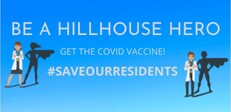 Thursday, December 24, 2020 8:30 p.m. - We are all working hard to maintain a tricky balance between being excited and energetic for the holiday and pressing the urgency to staff of being extra cautious at Christmas family gatherings. In the interests of keeping HillHouse safe from covid, we have asked staff to refrain from gathering with people outside their households or if they do gather, to be as careful as possible keeping masks on, maintaining physical distance, and practicing good hand hygiene. We have posted family cards and emails urging caution and expressing gratitude for staff efforts.Our HillHouse Heroes #SaveOurResidents campaign is underway and we have hung these posters throughout the building. We have heard from Guardian Long Term Care Pharmacy that skilled nursing facilities will be vaccinated before assisted living, so HillHouse will likely be scheduled for the covid vaccine clinic in mid-January. This depends, of course, on the supply of vaccine to Maine. As of this writing, supplies are less than requested and expected and there is uncertainty about how this will impact administration of the vaccine around Maine’s long term care facilities.
In the meantime, however, we are urging staff to read about vaccine safety and we have posted information and provided links to the CDC website. Many staff are concerned; despite the scientific community’s evidence of vaccine safety, there is so much disinformation on social media that people are easily caught up in it. We will continue to seek out ‘trusted others’ who can convincingly convey the message of vaccine safety for direct care workers. This fascinating podcast from MedPage highlights the troubling efforts that the anti-vax community has made to undermine confidence in the convid vaccine. mlc Sunday, December 6, 2020 8:30 p.m. - It seems best to reinstate the Pandemic Blog now that covid cases are rising sharply throughout Maine and here in Sagadahoc County. Based on the current 28-day rates, Maine DHHS guidance requires long term care providers to again suspend all visits (except for window visits, including those in our sealed foyer), suspend group activities, and non-essential medical appointments. We are still allowed communal dining as long as residents are seated 6’ apart, as we have done all year. In addition, HillHouse staff are required to wear eye protection at all times when around residents, so we have offered staff a few options for safety glasses and face shields.
We are anxiously awaiting further news on vaccine distribution. There is mixed news this weekend out of Washington. The Trump Administration has said vaccine distribution for long term care settings will begin in late December or certainly by mid-January. The incoming Biden Administration sounds less hopeful and has expressed concern about the lack of a comprehensive vaccine distribution plan. While each state has submitted an Interim Vaccine Distribution Plan (click here for Maine’s), states are relying on the federal government’s procurement of the vaccine supply from the manufacturers and distributors once the FDA has approved them for emergency use. We are partnering with Guardian Pharmacy - our pharmaceutical supplier - to administer the vaccine. If Guardian is unable to do so, then Walgreens Pharmacy is the back-up provider. This coming week we will prepare our internal covid vaccine administration plan modeled on the steps HillHouse has taken each year when CHANS administers the seasonal flu vaccine. We will poll the staff and encourage each of them to get the covid vaccine as soon as it is available so that residents are protected. We are searching for ways to persuade staff who may be hesitant and mistrusting of the speed in which the covid vaccine was developed. The good news is that resident life is proceeding as normally as possible and the Social Services staff are rising to the occasion with 1:1 activities and hallway activities to keep the mood festive during this holiday season. Santa will be visiting at lunch on December 18th and handing out presents for all residents. Until then there will be lots of festive music, special holiday treats, and plenty of decorations. The staff are still doing short drives in town with just one resident at a time to see the holiday lights. This is a good time for all family members and friends to send cards and letters -- they are good for the soul AND they provide another opportunity for staff to pay a visit to a resident! mlc Many HillHouse family members know that I have been posting to this Pandemic Blog since the covid pandemic began in mid-March 2020. I will continue through the Fall and Winter, as we are seeing upticks in Maine cases, particularly in York County. This puts us all on higher alert. Daily life at HillHouse, for the most, continues in a lovely rhythm of the changing seasons, though everything we do is tinged with unavoidable worry and sadness. We continue in our efforts to clean up and clean out exterior and interior spaces; work that was unattended in the frantic early months of the pandemic. We are very excited about our North Wing Garden project that is well underway and we are reviving the planned renovation of rooms G1 and G2 into a small suite that would be suitable for one resident who wanted more room space or a couple who wanted a separate bedroom and sitting area. Stay tuned.  Do you wonder if there is a difference between social isolation and loneliness? There is a difference, even though we often use the terms interchangeably. Click on the image below to read this paper on why the difference matters. 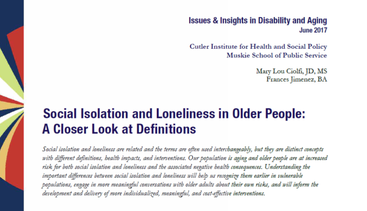 |
Blog
Mary Lou Ciolfi, JD, MS, HillHouse's former Administrator, is currently a Senior Program Manager at the University of Maine Center on Aging and Co-Director of the Consortium for Aging Policy Research and Analysis (CAPRA). She holds an adjunct faculty position at the University of New England and the University where she teaches courses in Health Policy and Aging Politics, Policy & Law. She has particular interests in Ageism, Social Isolation and Loneliness in Older People, and End-of Life Care. Archives
April 2024
Categories |
||
 RSS Feed